Biomechanics Of Sport And Exercise Pdf Download Mcginnis
| Skeletal muscle | |
|---|---|
 A height-down view of skeletal muscle | |
| Details | |
| Synonyms | Skeletal striated muscle / Striated voluntary muscle |
| Arrangement | Muscular system |
| Identifiers | |
| Latin | muscularis skeletalis |
| MeSH | D018482 |
| TH | H2.00.05.2.00002 |
| Anatomical terminology [edit on Wikidata] | |
Skeletal muscles (commonly referred to as muscles) are organs of the vertebrate muscular arrangement that are mostly attached past tendons to basic of the skeleton.[1] [2] The muscle cells of skeletal muscles are much longer than in the other types of muscle tissue, and are oft known as muscle fibers.[3] The muscle tissue of a skeletal muscle is striated – having a striped appearance due to the arrangement of the sarcomeres.
Skeletal muscles are voluntary muscles under the control of the somatic nervous system. The other types of muscle are cardiac musculus which is also striated and smooth musculus which is non-striated; both of these types of muscle tissue are classified as involuntary, or, under the control of the autonomic nervous arrangement.[iv]
A skeletal muscle contains multiple fascicles – bundles of muscle fibers. Each private cobweb, and each muscle is surrounded past a type of connective tissue layer of fascia. Muscle fibers are formed from the fusion of developmental myoblasts in a process known as myogenesis resulting in long multinucleated cells. In these cells the nuclei termed myonuclei are located forth the inside of the prison cell membrane. Muscle fibers also have multiple mitochondria to meet energy needs.
Musculus fibers are in plough composed of myofibrils. The myofibrils are composed of actin and myosin filaments called myofilaments, repeated in units called sarcomeres, which are the basic functional, contractile units of the muscle fiber necessary for muscle contraction.[5] Muscles are predominantly powered by the oxidation of fats and carbohydrates, but anaerobic chemical reactions are likewise used, particularly past fast twitch fibers. These chemical reactions produce adenosine triphosphate (ATP) molecules that are used to power the motility of the myosin heads.[half-dozen]
Construction [edit]
Gross anatomy [edit]

Front view of major skeletal muscles

Back view of major skeletal muscles
There are more than 600 skeletal muscles in the man body, making up around 40% to fifty% of trunk weight.[7] [8] Most muscles occur in bilaterally-placed pairs to serve both sides of the body. Muscles are often classed as groups of muscles that work together to acquit out an action. In the body at that place are several major musculus groups including the pectoral, and abdominal muscles; intrinsic and extrinsic muscles are subdivisions of musculus groups in the mitt, pes, tongue, and extraocular muscles of the eye. Muscles are also grouped into compartments including four groups in the arm, and the four groups in the leg.
Apart from the contractile part of a muscle consisting of its fibers, a muscle contains a non-contractile part of dense fibrous connective tissue that makes upward the tendon at each finish. The tendons attach the muscles to bones to give skeletal movement. The length of a muscle includes the tendons. Connective tissue is nowadays in all muscles as deep fascia. Deep fascia specialises inside muscles to enclose each muscle fiber as endomysium; each muscle fascicle as perimysium, and each individual muscle equally epimysium. Together these layers are chosen mysia. Deep fascia also separates the groups of muscles into muscle compartments.
Two types of sensory receptors establish in muscles are muscle spindles, and Golgi tendon organs. Muscle spindles are stretch receptors located in the muscle belly. Golgi tendon organs are proprioceptors located at the myotendinous junction that inform of a muscle's tension.
Skeletal muscle fibers [edit]

3D rendering of a skeletal muscle fiber
Skeletal muscle cells are the individual contractile cells within a musculus, and are often termed every bit muscle fibers.[two] A single musculus such equally the biceps in a young adult male contains around 253,000 muscle fibers.[9]
Skeletal muscle fibers are the simply muscle cells that are multinucleated with the nuclei ofttimes referred to as myonuclei. This occurs during myogenesis with the fusion of myoblasts each contributing a nucleus.[x] Fusion depends on muscle-specific proteins known as fusogens chosen myomaker and myomerger.[xi]
Many nuclei are needed by the skeletal muscle cell for the large amounts of proteins and enzymes needed to be produced for the cell'south normal functioning. A single muscle fiber can contain from hundreds to thousands of nuclei.[12] A muscle fiber for example in the man biceps with a length of 10 cm tin have every bit many equally 3000 nuclei.[12] Unlike in a non-muscle cell where the nucleus is centrally positioned, the myonucleus is elongated and located close to the sarcolemma. The myonuclei are quite uniformly arranged along the cobweb with each nucleus having its ain myonuclear domain where it is responsible for supporting the book of cytoplasm in that particular section of the myofiber.[eleven] [12]
A grouping of muscle stem cells known as myosatellite cells, likewise satellite cells are constitute betwixt the basement membrane and the sarcolemma of muscle fibers. These cells are normally quiescent simply can exist activated by exercise or pathology to provide boosted myonuclei for muscle growth or repair.[13]
Attachment to tendons [edit]
Muscles adhere to tendons in a circuitous interface region known every bit the musculotendinous junction also known as the myotendinous junction, an area specialised for the primary transmission of force.[14] At the muscle-tendon interface, force is transmitted from the sarcomeres in the musculus cells to the tendon.[5] Muscles and tendons develop in close association, and after their joining at the myotendinous junction they found a dynamic unit for the transmission of force from muscle wrinkle to the skeletal organisation.[fourteen]
Arrangement of muscle fibers [edit]

Muscle types past fiber organisation
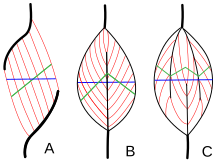
Muscle architecture refers to the arrangement of muscle fibers relative to the axis of force generation, which runs from a muscle's origin to its insertion. The usual arrangements are types of parallel, and types of pennate muscle. In parallel muscles the fascicles run parallel to the axis of force generation, but the fascicles can vary in their relationship to 1 some other, and to their tendons.[15] These variations are seen in fusiform, strap, and convergent muscles.[iii] A convergent muscle has a triangular or fan-shape every bit the fibers converge at its insertion and are fanned out broadly at the origin.[15] A less common example of a parallel muscle is a circular muscle such as the orbicularis oculi, in which the fibers are longitudinally arranged, but create a circumvolve from origin to insertion.[16] These different architectures, can cause variations in the tension that a muscle tin create between its tendons.
The fibers in pennate muscles run at an angle to the axis of forcefulness generation.[16] This pennation bending reduces the effective force of any individual fiber, every bit information technology is effectively pulling off-centrality. Still, because of this bending, more fibers can be packed into the same muscle book, increasing the physiological cross-sectional area (PCSA). This event is known as cobweb packing, and in terms of forcefulness generation, it more than than overcomes the efficiency-loss of the off-axis orientation. The trade-off comes in overall speed of muscle shortening and in the total excursion. Overall muscle shortening speed is reduced compared to fiber shortening speed, as is the full altitude of shortening.[16] All of these effects scale with pennation angle; greater angles lead to greater strength due to increased fiber packing and PCSA, but with greater losses in shortening speed and excursion. Types of pennate muscle are unipennate, bipennate, and multipennate. A unipennate muscle has similarly angled fibers that are on ane side of a tendon. A bipennate muscle has fibers on two sides of a tendon. Multipennate muscles have fibers that are oriented at multiple angles along the force-generating axis, and this is the well-nigh general and almost mutual architecture.[16]
Muscle fiber growth [edit]
Muscle fibers grow when exercised and shrink when not in use. This is due to the fact that exercise stimulates the increase in myofibrils which increment the overall size of muscle cells. Well exercised muscles can not only add more than size but can besides develop more mitochondria, myoglobin, glycogen and a higher density of capillaries. However muscle cells cannot separate to produce new cells, and equally a upshot in that location are fewer muscle cells in an adult than in a newborn.[17]
Muscle naming [edit]
There are a number of terms used in the naming of muscles including those relating to size, shape, action, location, their orientation, and their number of heads.
- By size
- brevis ways short; longus means long; longissimus means longest; magnus means big; major means larger; maximus means largest; small-scale means smaller, and minimus smallest; latissimus means widest, and vastus ways huge.[18] These terms are ofttimes used after the detail muscle such as gluteus maximus, and gluteus minimus.[19]
- By relative shape
- deltoid means triangular; quadratus means having four sides; rhomboideus ways having a rhomboid shape; teres ways round or cylindrical, and trapezius means having a trapezoid shape;[19] serratus means saw-toothed; orbicularis ways circular; pectinate means comblike; piriformis means pear-shaped; platys means apartment and gracilis ways slender.[18] Examples are the pronator teres, and the pronator quadratus.
- By action
- abductor moving away from the midline; adductor moving towards the midline; depressor moving downwards; elevator moving upwards; flexor moving that decreases an angle; extensor moving that increase an angle or straightens; pronator moving to face down; supinator moving to face upwards;[19] internal rotator rotating towards the body; external rotator rotating abroad from the trunk; sphincter decreases the size, and tensor gives tension to; fixator muscles serve to fix a articulation in a given position by stabilizing the prime mover whilst other joints are moving.
- Past number of heads
- biceps two; triceps 3 and quadriceps four.[19]
- By location
- named after the near primary structure such equally the temporal muscle (temporalis) near to the temporal bone.[18] Also supra- higher up; infra- below, and sub- under.[seven]
- By fascicle orientation
- Relative to the midline, rectus means parallel to the midline; transverse ways perpendicular to the midline, and oblique means diagonal to the midline.[18] Relative to the centrality of the generation of forcefulness – types of parallel, and types of pennate muscles.
Fiber types [edit]
Broadly in that location are two types of musculus fiber: Blazon I, which is slow, and Type 2 which are fast. Type II has two divisions of type IIA (oxidative), and type IIX (glycolytic), giving three main fiber types.[twenty] These fibers take relatively distinct metabolic, contractile, and motor unit properties. The table below differentiates these types of properties. These types of properties—while they are partly dependent on the properties of individual fibers—tend to exist relevant and measured at the level of the motor unit of measurement, rather than individual fiber.[21]
| Properties | Type I fibers | Blazon IIA fibers | Blazon IIX fibers |
|---|---|---|---|
| Motor Unit Type | Boring Oxidative (SO) | Fast Oxidative/Glycolytic (FOG) | Fast Glycolytic (FG) |
| Twitch speed | Slow | Fast | Fast |
| Twitch strength | Small | Medium | Big |
| Resistance to fatigue | Loftier | Loftier | Low |
| Glycogen content | Low | High | High |
| Capillary supply | Rich | Rich | Poor |
| Capillary density | High | Intermediate | Low |
| Myoglobin | High | High | Low |
| Carmine color | Dark | Nighttime | Pale |
| Mitochondrial density | High | High | Low |
| Oxidative enzyme chapters | High | Intermediate-high | Low |
| Z-line width | Intermediate | Wide | Narrow |
| Element of group i ATPase activeness | Low | High | Loftier |
| Acidic ATPase activity | High | Medium-high | Low |
Fiber color [edit]
Traditionally, fibers were categorized depending on their varying color, which is a reflection of myoglobin content. Type I fibers announced red due to the high levels of myoglobin. Red muscle fibers tend to take more mitochondria and greater local capillary density. These fibers are more than suited for endurance and are slow to fatigue considering they utilize oxidative metabolism to generate ATP (adenosine triphosphate). Less oxidative Type 2 fibers are white due to relatively low myoglobin and a reliance on glycolytic enzymes.
Twitch speed [edit]
Fibers tin also be classified on their twitch capabilities, into fast and deadening twitch. These traits largely, but not completely, overlap the classifications based on color, ATPase, or MHC.
Some authors ascertain a fast twitch fiber every bit one in which the myosin tin can split ATP very apace. These mainly include the ATPase blazon II and MHC type Two fibers. Even so, fast twitch fibers as well demonstrate a college adequacy for electrochemical transmission of action potentials and a rapid level of calcium release and uptake by the sarcoplasmic reticulum. The fast twitch fibers rely on a well-adult, anaerobic, short term, glycolytic system for energy transfer and can contract and develop tension at two–3 times the rate of slow twitch fibers. Fast twitch muscles are much meliorate at generating short bursts of forcefulness or speed than slow muscles, and so fatigue more quickly.[22]
The ho-hum twitch fibers generate energy for ATP re-synthesis by ways of a long term organisation of aerobic energy transfer. These mainly include the ATPase type I and MHC type I fibers. They tend to have a depression activity level of ATPase, a slower speed of contraction with a less well developed glycolytic capacity.[22] Fibers that become tiresome-twitch develop greater numbers of mitochondria and capillaries making them better for prolonged piece of work.[23]
- Type distribution
Individual muscles tend to be a mixture of various fiber types, but their proportions vary depending on the deportment of that muscle. For case, in humans, the quadriceps muscles contain ~52% type I fibers, while the soleus is ~80% type I.[24] The orbicularis oculi muscle of the eye is only ~15% type I.[24] Motor units within the muscle, however, have minimal variation between the fibers of that unit. It is this fact that makes the size chief of motor unit of measurement recruitment feasible.
The total number of skeletal musculus fibers has traditionally been idea non to alter. Information technology is believed there are no sexual activity or age differences in fiber distribution; notwithstanding, proportions of fiber types vary considerably from musculus to muscle and person to person.[ citation needed ] Among unlike species in that location is a much variation in the proportions of muscle fiber types.[25]
Sedentary men and women (equally well equally young children) have 45% type II and 55% type I fibers.[ citation needed ] People at the college end of any sport tend to demonstrate patterns of fiber distribution e.g. endurance athletes bear witness a higher level of type I fibers. Sprint athletes, on the other hand, require big numbers of blazon IIX fibers. Middle-distance result athletes evidence approximately equal distribution of the ii types. This is also often the case for ability athletes such as throwers and jumpers. Information technology has been suggested that various types of exercise can induce changes in the fibers of a skeletal muscle.[26]
It is thought that if you perform endurance type events for a sustained period of time, some of the type IIX fibers transform into blazon IIA fibers. Withal, there is no consensus on the subject. It may well exist that the type IIX fibers show enhancements of the oxidative capacity afterwards high intensity endurance preparation which brings them to a level at which they are able to perform oxidative metabolism as effectively as slow twitch fibers of untrained subjects. This would be brought well-nigh by an increase in mitochondrial size and number and the associated related changes, not a alter in fiber type.
Cobweb typing methods [edit]

ATPase staining of a muscle cross section. Type Ii fibers are dark, due to the alkaline pH of the grooming. In this example, the size of the type II fibers is considerably less than the type I fibers due to denervation atrophy.
There are numerous methods employed for fiber-typing, and confusion between the methods is mutual among non-experts. Two unremarkably confused methods are histochemical staining for myosin ATPase activity and immunohistochemical staining for myosin heavy chain (MHC) type. Myosin ATPase activity is commonly—and correctly—referred to as simply "fiber blazon", and results from the direct assaying of ATPase activeness under various conditions (e.thousand. pH).[21] Myosin heavy concatenation staining is almost accurately referred to as "MHC fiber type", e.grand. "MHC IIa fibers", and results from determination of different MHC isoforms.[21] These methods are closely related physiologically, as the MHC blazon is the primary determinant of ATPase activity. However, neither of these typing methods is directly metabolic in nature; they do not directly address oxidative or glycolytic capacity of the fiber.
When "type I" or "type 2" fibers are referred to generically, this nearly accurately refers to the sum of numerical fiber types (I vs. 2) as assessed by myosin ATPase action staining (east.g. "type Ii" fibers refers to type IIA + type IIAX + type IIXA ... etc.).
Below is a table showing the relationship between these two methods, express to fiber types found in humans. Subtype capitalization is used in fiber typing vs. MHC typing, and some ATPase types really contain multiple MHC types. As well, a subtype B or b is not expressed in humans past either method.[27] Early researchers believed humans to express a MHC IIb, which led to the ATPase nomenclature of IIB. However, later research showed that the human MHC IIb was in fact IIx,[27] indicating that the IIB is improve named IIX. IIb is expressed in other mammals, so is still accurately seen (along with IIB) in the literature. Not homo fiber types include true IIb fibers, IIc, IId, etc.
| ATPase type | MHC heavy chain(s) |
|---|---|
| Type I | MHC Iβ |
| Type IC | MHC Iβ > MHC IIa |
| Type IIC | MHC IIa > MHC Iβ |
| Type IIA | MHC IIa |
| Blazon IIAX | MHC IIa > MHC IIx |
| Type IIXA | MHC IIx > MHC IIa |
| Blazon IIX | MHC IIx |
Farther cobweb typing methods are less formally delineated, and exist on more than of a spectrum. They tend to exist focused more than on metabolic and functional capacities (i.e., oxidative vs. glycolytic, fast vs. slow contraction time). As noted higher up, fiber typing by ATPase or MHC does not directly measure or dictate these parameters. However, many of the diverse methods are mechanistically linked, while others are correlated in vivo.[thirty] [31] For instance, ATPase fiber type is related to contraction speed, considering high ATPase activity allows faster crossbridge cycling.[21] While ATPase activity is only one component of wrinkle speed, Type I fibers are "slow", in office, considering they have depression speeds of ATPase action in comparison to Blazon II fibers. However, measuring contraction speed is not the same every bit ATPase fiber typing.
Microanatomy [edit]

Structure of muscle fibre showing a sarcomere under electron microscope with schematic caption.
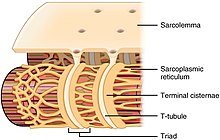
Diagram of sarcoplasmic reticulum with terminal cisternae and T-tubules.
Skeletal musculus exhibits a distinctive banding pattern when viewed nether the microscope due to the arrangement of two contractile proteins myosin, and actin – that are two of the myofilaments in the myofibrils. The myosin forms the thick filaments, and actin forms the thin filaments, and are arranged in repeating units called sarcomeres. The interaction of both proteins results in musculus contraction.
The sarcomere is attached to other organelles such as the mitochondria past intermediate filaments in the cytoskeleton. The costamere attaches the sarcomere to the sarcolemma.[5]
Every single organelle and macromolecule of a muscle cobweb is arranged to ensure that it meets desired functions. The cell membrane is called the sarcolemma with the cytoplasm known as the sarcoplasm. In the sarcoplasm are the myofibrils. The myofibrils are long protein bundles nearly i micrometer in diameter. Pressed against the inside of the sarcolemma are the unusual flattened myonuclei. Betwixt the myofibrils are the mitochondria.
While the muscle fiber does not have smooth endoplasmic cisternae, information technology contains sarcoplasmic reticulum. The sarcoplasmic reticulum surrounds the myofibrils and holds a reserve of the calcium ions needed to cause a musculus contraction. Periodically, information technology has dilated terminate sacs known equally terminal cisternae. These cross the muscle cobweb from ane side to the other. In between 2 terminal cisternae is a tubular infolding called a transverse tubule (T tubule). T tubules are the pathways for action potentials to signal the sarcoplasmic reticulum to release calcium, causing a muscle contraction. Together, ii last cisternae and a transverse tubule form a triad.[32]
Evolution [edit]

All muscles are derived from paraxial mesoderm. During embryonic evolution in the procedure of somitogenesis the paraxial mesoderm is divided along the embryo's length to form somites, corresponding to the sectionalisation of the body virtually obviously seen in the vertebral column.[33] Each somite has three divisions, sclerotome (which forms vertebrae), dermatome (which forms skin), and myotome (which forms muscle). The myotome is divided into two sections, the epimere and hypomere, which form epaxial and hypaxial muscles, respectively. The just epaxial muscles in humans are the erector spinae and small vertebral muscles, and are innervated by the dorsal rami of the spinal fretfulness. All other muscles, including those of the limbs are hypaxial, and innervated by the ventral rami of the spinal nerves.[33]
During evolution, myoblasts (muscle progenitor cells) either remain in the somite to form muscles associated with the vertebral cavalcade or migrate out into the torso to course all other muscles. Myoblast migration is preceded by the germination of connective tissue frameworks, usually formed from the somatic lateral plate mesoderm. Myoblasts follow chemical signals to the appropriate locations, where they fuse into elongated multinucleated skeletal muscle cells.[33]
Between the tenth and the eighteenth weeks of gestation, all muscle cells have fast myosin heavy chains; 2 myotube types become distinguished in the developing fetus – both expressing fast bondage but one expressing fast and slow chains. Between x and twoscore per cent of the fibers express the tedious myosin chain.[34]
Cobweb types are established during embryonic development and are remodelled later in the adult by neural and hormonal influences.[25] The population of satellite cells nowadays underneath the basal lamina is necessary for the postnatal development of musculus cells.[35]
Function [edit]
The chief function of muscle is contraction.[2] Following contraction, skeletal muscle functions every bit an endocrine organ by secreting myokines – a wide range of cytokines and other peptides that act as signalling molecules.[36] Myokines in turn are believed to mediate the health benefits of practise.[37] Myokines are secreted into the bloodstream after muscle wrinkle. Interleukin 6 (IL-6) is the near studied myokine, other musculus contraction-induced myokines include BDNF, FGF21, and SPARC.[38]
Muscle also functions to produce body heat. Muscle contraction is responsible for producing 85% of the body's heat.[39] This heat produced is as a past-product of muscular activity, and is generally wasted. Equally a homeostatic response to extreme common cold, muscles are signaled to trigger contractions of shivering in order to generate heat.[40]
Contraction [edit]

When a sarcomere contracts, the Z lines move closer together, and the I ring becomes smaller. The A band stays the same width. At total contraction, the thin and thick filaments overlap.
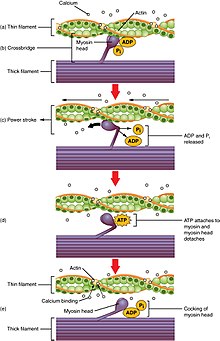
Contraction in more item
Contraction is achieved by the muscle's structural unit the muscle fiber, and by its functional unit, the motor unit of measurement.[3] Muscle fibers are excitable cells stimulated by motor neurons. The motor unit of measurement consists of a motor neuron and the many fibers that it makes contact with. A single muscle is stimulated by many motor units. Muscle fibers are bailiwick to depolarization by the neurotransmitter acetylcholine, released by the motor neurons at the neuromuscular junctions.[41]
In addition to the actin and myosin myofilaments in the myofibrils that make up the contractile sarcomeres, there are ii other important regulatory proteins – troponin and tropomyosin, that make muscle contraction possible. These proteins are associated with actin and cooperate to foreclose its interaction with myosin. Once a jail cell is sufficiently stimulated, the jail cell's sarcoplasmic reticulum releases ionic calcium (Catwo+), which then interacts with the regulatory protein troponin. Calcium-bound troponin undergoes a conformational modify that leads to the movement of tropomyosin, after exposing the myosin-binding sites on actin. This allows for myosin and actin ATP-dependent cross-bridge cycling and shortening of the muscle.
Excitation-contraction coupling [edit]
Excitation contraction coupling is the process by which a muscular activeness potential in the muscle cobweb causes the myofibrils to contract. This procedure relies on a direct coupling between the sarcoplasmic reticulum calcium release channel RYR1 (ryanodine receptor 1), and voltage-gated L-type calcium channels (identified as dihydropyridine receptors, DHPRs). DHPRs are located on the sarcolemma (which includes the surface sarcolemma and the transverse tubules), while the RyRs reside across the SR membrane. The close apposition of a transverse tubule and two SR regions containing RyRs is described as a triad and is predominantly where excitation–contraction coupling takes place. Excitation–contraction coupling occurs when depolarization of skeletal muscle cell results in a musculus action potential, which spreads beyond the jail cell surface and into the muscle fiber'due south network of T-tubules, thereby depolarizing the inner portion of the muscle cobweb. Depolarization of the inner portions activates dihydropyridine receptors in the concluding cisternae, which are in close proximity to ryanodine receptors in the adjacent sarcoplasmic reticulum. The activated dihydropyridine receptors physically collaborate with ryanodine receptors to activate them via pes processes (involving conformational changes that allosterically activates the ryanodine receptors). Equally the ryanodine receptors open, Ca 2+
is released from the sarcoplasmic reticulum into the local junctional space and diffuses into the bulk cytoplasm to crusade a calcium spark. Notation that the sarcoplasmic reticulum has a big calcium buffering capacity partially due to a calcium-bounden protein chosen calsequestrin. The near synchronous activation of thousands of calcium sparks past the action potential causes a cell-wide increase in calcium giving ascent to the upstroke of the calcium transient. The Ca ii+
released into the cytosol binds to Troponin C by the actin filaments, to allow crossbridge cycling, producing force and, in some situations, motion. The sarco/endoplasmic reticulum calcium-ATPase (SERCA) actively pumps Ca two+
dorsum into the sarcoplasmic reticulum. As Ca 2+
declines dorsum to resting levels, the force declines and relaxation occurs.[42]
Muscle movement [edit]
The efferent leg of the peripheral nervous system is responsible for conveying commands to the muscles and glands, and is ultimately responsible for voluntary motility. Nerves move muscles in response to voluntary and autonomic (involuntary) signals from the encephalon. Deep muscles, superficial muscles, muscles of the face and internal muscles all correspond with dedicated regions in the primary motor cortex of the brain, directly anterior to the cardinal sulcus that divides the frontal and parietal lobes.
In addition, muscles react to reflexive nervus stimuli that practice non e'er send signals all the way to the encephalon. In this case, the signal from the afferent fiber does not attain the brain, but produces the reflexive movement by direct connections with the efferent nerves in the spine. However, the majority of muscle action is volitional, and the result of complex interactions betwixt various areas of the brain.
Nerves that control skeletal muscles in mammals stand for with neuron groups along the principal motor cortex of the brain's cerebral cortex. Commands are routed through the basal ganglia and are modified by input from the cerebellum before beingness relayed through the pyramidal tract to the spinal string and from there to the motor terminate plate at the muscles. Along the mode, feedback, such every bit that of the extrapyramidal system contribute signals to influence muscle tone and response.
Deeper muscles such every bit those involved in posture oftentimes are controlled from nuclei in the brain stem and basal ganglia.
Proprioception [edit]
In skeletal muscles, muscle spindles convey data about the caste of muscle length and stretch to the fundamental nervous system to assist in maintaining posture and articulation position. The sense of where our bodies are in infinite is called proprioception, the perception of torso awareness, the "unconscious" sensation of where the diverse regions of the body are located at any one fourth dimension. Several areas in the encephalon coordinate move and position with the feedback data gained from proprioception. The cerebellum and carmine nucleus in particular continuously sample position confronting movement and brand small-scale corrections to assure polish motion.[ commendation needed ]
Energy consumption [edit]
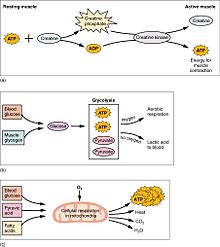
(a) Some ATP is stored in a resting muscle. As wrinkle starts, it is used up in seconds. More ATP is generated from creatine phosphate for about fifteen seconds. (b) Each glucose molecule produces two ATP and 2 molecules of pyruvic acid, which tin be used in aerobic respiration or converted to lactic acrid. If oxygen is not bachelor, pyruvic acid is converted to lactic acid, which may contribute to muscle fatigue. This occurs during strenuous exercise when high amounts of free energy are needed simply oxygen cannot be sufficiently delivered to muscle. (c) Aerobic respiration is the breakdown of glucose in the presence of oxygen (O2) to produce carbon dioxide, water, and ATP. Approximately 95 percent of the ATP required for resting or moderately active muscles is provided by aerobic respiration, which takes identify in mitochondria.
Muscular activity accounts for much of the trunk's free energy consumption. All muscle cells produce adenosine triphosphate (ATP) molecules which are used to power the move of the myosin heads. Muscles have a short-term store of energy in the course of creatine phosphate which is generated from ATP and tin can regenerate ATP when needed with creatine kinase. Muscles also go along a storage form of glucose in the form of glycogen. Glycogen can exist rapidly converted to glucose when energy is required for sustained, powerful contractions. Inside the voluntary skeletal muscles, the glucose molecule can be metabolized anaerobically in a process called glycolysis which produces 2 ATP and two lactic acrid molecules in the procedure (note that in aerobic conditions, lactate is non formed; instead pyruvate is formed and transmitted through the citric acrid cycle). Muscle cells also incorporate globules of fat, which are used for energy during aerobic exercise. The aerobic energy systems accept longer to produce the ATP and accomplish peak efficiency, and requires many more biochemical steps, but produces significantly more ATP than anaerobic glycolysis. Cardiac muscle on the other hand, can readily consume whatever of the 3 macronutrients (protein, glucose and fatty) aerobically without a 'warm up' menstruation and e'er extracts the maximum ATP yield from any molecule involved. The heart, liver and red claret cells will likewise consume lactic acid produced and excreted past skeletal muscles during practise.
Skeletal muscle uses more calories than other organs.[43] At residual it consumes 54.iv kJ/kg (thirteen.0 kcal/kg) per day. This is larger than adipose tissue (fat) at xviii.eight kJ/kg (4.5 kcal/kg), and bone at 9.half-dozen kJ/kg (2.3 kcal/kg).[44]
Efficiency [edit]
The efficiency of homo muscle has been measured (in the context of rowing and cycling) at 18% to 26%. The efficiency is defined as the ratio of mechanical work output to the full metabolic cost, equally can exist calculated from oxygen consumption. This low efficiency is the result of virtually 40% efficiency of generating ATP from nutrient energy, losses in converting free energy from ATP into mechanical work inside the muscle, and mechanical losses within the trunk. The latter two losses are dependent on the type of exercise and the type of muscle fibers being used (fast-twitch or deadening-twitch). For an overall efficiency of 20 percent, one watt of mechanical ability is equivalent to 4.3 kcal per 60 minutes. For example, ane manufacturer of rowing equipment calibrates its rowing ergometer to count burned calories as equal to four times the actual mechanical work, plus 300 kcal per hour, this amounts to most 20 percent efficiency at 250 watts of mechanical output. The mechanical energy output of a circadian contraction can depend upon many factors, including activation timing, muscle strain trajectory, and rates of strength rise & disuse. These tin can be synthesized experimentally using piece of work loop analysis.
Muscle strength [edit]
Muscle force is a outcome of three overlapping factors: physiological forcefulness (musculus size, cross sectional surface area, bachelor crossbridging, responses to grooming), neurological strength (how strong or weak is the bespeak that tells the muscle to contract), and mechanical strength (musculus's force bending on the lever, moment arm length, joint capabilities).[ commendation needed ]
| Course 0 | No contraction |
| Grade 1 | Trace of contraction, just no movement at the joint |
| Form 2 | Movement at the joint with gravity eliminated |
| Grade 3 | Movement against gravity, but not against added resistance |
| Class 4 | Movement against external resistance, merely less than normal |
| Grade v | Normal force |
Vertebrate muscle typically produces approximately 25–33 N (5.half-dozen–7.four lbf) of force per square centimeter of muscle cross-sectional area when isometric and at optimal length.[45] Some invertebrate muscles, such as in crab claws, have much longer sarcomeres than vertebrates, resulting in many more than sites for actin and myosin to bind and thus much greater strength per foursquare centimeter at the cost of much slower speed. The force generated by a wrinkle can be measured not-invasively using either mechanomyography or phonomyography, be measured in vivo using tendon strain (if a prominent tendon is nowadays), or be measured directly using more invasive methods.
The strength of whatsoever given musculus, in terms of force exerted on the skeleton, depends upon length, shortening speed, cross sectional area, pennation, sarcomere length, myosin isoforms, and neural activation of motor units. Pregnant reductions in musculus forcefulness tin indicate underlying pathology, with the chart at right used as a guide.
The "strongest" homo muscle [edit]
Since three factors impact muscular strength simultaneously and muscles never work individually, it is misleading to compare strength in individual muscles, and state that one is the "strongest". Only below are several muscles whose strength is noteworthy for unlike reasons.
- In ordinary parlance, muscular "strength" usually refers to the ability to exert a force on an external object—for case, lifting a weight. Past this definition, the masseter or jaw musculus is the strongest. The 1992 Guinness Volume of Records records the achievement of a bite forcefulness of 4,337 N (975 lbf) for 2 seconds. What distinguishes the masseter is not anything special about the muscle itself, just its advantage in working confronting a much shorter lever arm than other muscles.
- If "strength" refers to the strength exerted by the muscle itself, e.1000., on the place where information technology inserts into a bone, and so the strongest muscles are those with the largest cross-sectional area. This is because the tension exerted by an individual skeletal muscle fiber does not vary much. Each fiber can exert a force on the order of 0.3 micronewton. By this definition, the strongest musculus of the trunk is usually said to be the quadriceps femoris or the gluteus maximus.
- Because musculus strength is determined past cross-exclusive area, a shorter musculus volition be stronger "pound for pound" (i.eastward., by weight) than a longer muscle of the aforementioned cantankerous-exclusive area. The myometrial layer of the uterus may be the strongest musculus by weight in the female human being torso. At the time when an baby is delivered, the unabridged human uterus weighs virtually 1.one kg (40 oz). During childbirth, the uterus exerts 100 to 400 N (25 to 100 lbf) of downward strength with each wrinkle.
- The external muscles of the middle are conspicuously big and strong in relation to the small-scale size and weight of the eyeball. It is frequently said that they are "the strongest muscles for the job they take to do" and are sometimes claimed to be "100 times stronger than they demand to be." Even so, eye movements (particularly saccades used on facial scanning and reading) do crave loftier speed movements, and middle muscles are exercised nightly during rapid middle movement slumber.
- The statement that "the tongue is the strongest muscle in the body" appears often in lists of surprising facts, but information technology is difficult to find whatever definition of "strength" that would brand this statement true. Note that the tongue consists of eight muscles, not one.
Force generation [edit]
Musculus force is proportional to physiological cross-sectional expanse (PCSA), and muscle velocity is proportional to muscle cobweb length.[46] The torque around a joint, however, is adamant past a number of biomechanical parameters, including the distance between musculus insertions and pivot points, muscle size and architectural gear ratio. Muscles are ordinarily arranged in opposition so that when one group of muscles contracts, another group relaxes or lengthens.[47] Animosity in the manual of nerve impulses to the muscles ways that it is incommunicable to fully stimulate the contraction of 2 antagonistic muscles at whatever one fourth dimension. During ballistic motions such as throwing, the adversary muscles human activity to 'restriction' the agonist muscles throughout the contraction, particularly at the end of the movement. In the example of throwing, the chest and forepart of the shoulder (anterior deltoid) contract to pull the arm forward, while the muscles in the back and rear of the shoulder (posterior deltoid) also contract and undergo eccentric wrinkle to tiresome the move downwardly to avoid injury. Office of the grooming process is learning to relax the antagonist muscles to increase the force input of the breast and anterior shoulder.
Contracting muscles produce vibration and sound.[48] Slow twitch fibers produce 10 to 30 contractions per second (10 to thirty Hz). Fast twitch fibers produce 30 to seventy contractions per 2nd (30 to seventy Hz).[49] The vibration tin can be witnessed and felt by highly tensing 1's muscles, equally when making a firm fist. The audio tin be heard by pressing a highly tensed musculus confronting the ear, again a firm fist is a proficient example. The sound is ordinarily described as a rumbling sound. Some individuals tin can voluntarily produce this rumbling sound past contracting the tensor tympani muscle of the eye ear. The rumbling sound can also be heard when the neck or jaw muscles are highly tensed.[ commendation needed ]
Signal transduction pathways [edit]
Skeletal musculus cobweb-type phenotype in adult animals is regulated by several independent signaling pathways. These include pathways involved with the Ras/mitogen-activated poly peptide kinase (MAPK) pathway, calcineurin, calcium/calmodulin-dependent protein kinase IV, and the peroxisome proliferator γ coactivator 1 (PGC-1). The Ras/MAPK signaling pathway links the motor neurons and signaling systems, coupling excitation and transcription regulation to promote the nerve-dependent induction of the wearisome programme in regenerating muscle. Calcineurin, a Ca2+/calmodulin-activated phosphatase implicated in nervus activity-dependent fiber-blazon specification in skeletal muscle, directly controls the phosphorylation land of the transcription factor NFAT, allowing for its translocation to the nucleus and leading to the activation of tedious-blazon muscle proteins in cooperation with myocyte enhancer factor 2 (MEF2) proteins and other regulatory proteins. Ca2+/calmodulin-dependent protein kinase activity is also upregulated past tedious motor neuron action, maybe because it amplifies the irksome-type calcineurin-generated responses by promoting MEF2 transactivator functions and enhancing oxidative chapters through stimulation of mitochondrial biogenesis.
Wrinkle-induced changes in intracellular calcium or reactive oxygen species provide signals to various pathways that include the MAPKs, calcineurin and calcium/calmodulin-dependent protein kinase IV to activate transcription factors that regulate cistron expression and enzyme activeness in skeletal muscle.
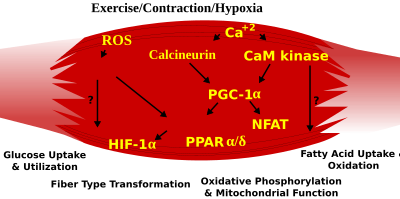
Practise-induced signaling pathways in skeletal muscle that decide specialized characteristics of slow- and fast-twitch muscle fibers
PGC1-α (PPARGC1A), a transcriptional coactivator of nuclear receptors important to the regulation of a number of mitochondrial genes involved in oxidative metabolism, directly interacts with MEF2 to synergistically activate selective slow twitch (ST) muscle genes and too serves as a target for calcineurin signaling. A peroxisome proliferator-activated receptor δ (PPARδ)-mediated transcriptional pathway is involved in the regulation of the skeletal muscle fiber phenotype. Mice that harbor an activated grade of PPARd display an "endurance" phenotype, with a coordinated increase in oxidative enzymes and mitochondrial biogenesis and an increased proportion of ST fibers. Thus—through functional genomics—calcineurin, calmodulin-dependent kinase, PGC-1α, and activated PPARδ form the basis of a signaling network that controls skeletal musculus fiber-type transformation and metabolic profiles that protect against insulin resistance and obesity.
The transition from aerobic to anaerobic metabolism during intense piece of work requires that several systems are rapidly activated to ensure a abiding supply of ATP for the working muscles. These include a switch from fat-based to saccharide-based fuels, a redistribution of claret flow from nonworking to exercising muscles, and the removal of several of the past-products of anaerobic metabolism, such equally carbon dioxide and lactic acrid. Some of these responses are governed by transcriptional control of the fast twitch (FT) glycolytic phenotype. For example, skeletal musculus reprogramming from an ST glycolytic phenotype to an FT glycolytic phenotype involves the Six1/Eya1 complex, equanimous of members of the Six protein family. Moreover, the hypoxia-inducible cistron 1-α (HIF1A) has been identified equally a chief regulator for the expression of genes involved in essential hypoxic responses that maintain ATP levels in cells. Ablation of HIF-1α in skeletal muscle was associated with an increase in the action of charge per unit-limiting enzymes of the mitochondria, indicating that the citric acid cycle and increased fatty acid oxidation may be compensating for decreased menses through the glycolytic pathway in these animals. Even so, hypoxia-mediated HIF-1α responses are too linked to the regulation of mitochondrial dysfunction through the formation of excessive reactive oxygen species in mitochondria.
Other pathways too influence adult musculus character. For example, physical force inside a musculus fiber may release the transcription factor serum response factor from the structural protein titin, leading to altered musculus growth.
Practise [edit]
Jogging is one class of aerobic exercise.
Exercise is often recommended as a means of improving motor skills, fettle, muscle and os strength, and articulation role. Practice has several effects upon muscles, connective tissue, bone, and the fretfulness that stimulate the muscles. One such outcome is musculus hypertrophy, an increase in size of musculus due to an increase in the number of muscle fibers or cantankerous-sectional expanse of myofibrils.[50] Musculus changes depend on the type of exercise used.
More often than not, in that location are 2 types of exercise regimes, aerobic and anaerobic. Aerobic practice (e.g. marathons) involves depression intensity, but long duration activities during which, the muscles used are below their maximal contraction strength. Aerobic activities rely on the aerobic respiration (i.e. citric acid cycle and electron transport concatenation) for metabolic free energy by consuming fat, protein, carbohydrates, and oxygen. Muscles involved in aerobic exercises contain a higher percentage of Type I (or slow-twitch) musculus fibers, which primarily comprise mitochondrial and oxidation enzymes associated with aerobic respiration.[51] [52] On the contrary, anaerobic practice is associated with short duration, but loftier intensity do (e.thousand. sprinting and weight lifting). The anaerobic activities predominately use Type II, fast-twitch, muscle fibers.[53] Blazon Two muscle fibers rely on glucogenesis for energy during anaerobic exercise.[54] During anaerobic exercise, type Ii fibers eat trivial oxygen, protein and fat, produces large amounts of lactic acid and are fatigable. Many exercises are partially aerobic and anaerobic; for case, soccer and rock climbing.
The presence of lactic acrid has an inhibitory effect on ATP generation inside the muscle. Information technology can fifty-fifty stop ATP production if the intracellular concentration becomes besides high. Withal, endurance preparation mitigates the buildup of lactic acid through increased capillarization and myoglobin.[55] This increases the ability to remove waste products, similar lactic acid, out of the muscles in order to not impair muscle function. Once moved out of muscles, lactic acid can be used by other muscles or body tissues as a source of energy, or transported to the liver where it is converted back to pyruvate. In addition to increasing the level of lactic acid, strenuous exercise results in the loss of potassium ions in musculus. This may facilitate the recovery of muscle function by protecting confronting fatigue.[56]
Delayed onset muscle soreness is pain or discomfort that may be felt one to iii days after exercising and generally subsides two to three days afterwards which. In one case idea to be caused by lactic acrid build-up, a more recent theory is that it is caused by tiny tears in the muscle fibers caused by eccentric contraction, or unaccustomed training levels. Since lactic acid disperses fairly rapidly, it could non explain pain experienced days after exercise.[57]
Clinical significance [edit]
Muscle disease [edit]
Diseases of skeletal muscle are termed myopathies, while diseases of nerves are called neuropathies. Both tin can touch on musculus function or cause muscle hurting, and fall under the umbrella of neuromuscular illness. The cause of many myopathies is attributed to mutations in the various associated muscle proteins.[5] [58] Some inflammatory myopathies include polymyositis and inclusion trunk myositis

Neuromuscular diseases affect the muscles and their nervous control. In general, bug with nervous control can cause spasticity or paralysis, depending on the location and nature of the trouble. A number of motility disorders are caused past neurological disorders such as Parkinson'southward disease and Huntington's illness where there is central nervous system dysfunction.[59]
Symptoms of musculus diseases may include weakness, spasticity, myoclonus and myalgia. Diagnostic procedures that may reveal muscular disorders include testing creatine kinase levels in the blood and electromyography (measuring electrical activity in muscles). In some cases, musculus biopsy may exist done to identify a myopathy, as well as genetic testing to place DNA abnormalities associated with specific myopathies and dystrophies.
A not-invasive elastography technique that measures muscle noise is undergoing experimentation to provide a way of monitoring neuromuscular disease. The sound produced past a muscle comes from the shortening of actomyosin filaments along the axis of the muscle. During wrinkle, the muscle shortens along its length and expands across its width, producing vibrations at the surface.[60]
Hypertrophy [edit]
Independent of forcefulness and performance measures, muscles can be induced to grow larger by a number of factors, including hormone signaling, developmental factors, strength grooming, and disease. Contrary to pop belief, the number of muscle fibres cannot be increased through practise. Instead, muscles grow larger through a combination of muscle cell growth as new protein filaments are added forth with additional mass provided past undifferentiated satellite cells alongside the existing muscle cells.[61]
Biological factors such equally age and hormone levels can bear upon musculus hypertrophy. During puberty in males, hypertrophy occurs at an accelerated rate every bit the levels of growth-stimulating hormones produced by the trunk increment. Natural hypertrophy ordinarily stops at full growth in the tardily teens. As testosterone is one of the trunk'southward major growth hormones, on average, men find hypertrophy much easier to achieve than women. Taking boosted testosterone or other anabolic steroids will increase muscular hypertrophy.
Muscular, spinal and neural factors all affect muscle edifice. Sometimes a person may notice an increase in strength in a given muscle even though but its opposite has been subject to do, such as when a bodybuilder finds her left biceps stronger after completing a regimen focusing but on the right biceps. This phenomenon is called cross education.[ citation needed ]
Atrophy [edit]

Prisoner of war exhibiting muscle loss every bit a outcome of malnutrition.
Every day between one and two percentage of muscle is cleaved down and rebuilt. Inactivity, malnutrition, illness, and aging can increment the breakdown leading to muscle atrophy or sarcopenia. Sarcopenia is commonly an age-related procedure that can cause frailty and its consequences.[62] A subtract in musculus mass may be accompanied by a smaller number and size of the muscle cells also as lower protein content.[63]
Homo spaceflight, involving prolonged periods of immobilization and weightlessness is known to result in musculus weakening and atrophy resulting in a loss of as much as 30% of mass in some muscles.[64] [65] Such consequences are likewise noted in some mammals post-obit hibernation.[66]
Many diseases and weather condition including cancer, AIDS, and heart failure can crusade muscle loss known as cachexia.[67]
Research [edit]
Myopathies take been modeled with cell culture systems of muscle from healthy or diseased tissue biopsies. Another source of skeletal muscle and progenitors is provided by the directed differentiation of pluripotent stem cells.[68] Inquiry on skeletal muscle properties uses many techniques. Electric musculus stimulation is used to determine forcefulness and wrinkle speed at different frequencies related to fiber-blazon composition and mix inside an individual muscle group. In vitro muscle testing is used for more than consummate characterization of musculus properties.
The electrical activity associated with muscle wrinkle is measured via electromyography (EMG). Skeletal musculus has two physiological responses: relaxation and contraction. The mechanisms for which these responses occur generate electrical activity measured past EMG. Specifically, EMG can mensurate the activeness potential of a skeletal muscle, which occurs from the hyperpolarization of the motor axons from nerve impulses sent to the musculus. EMG is used in research for determining if the skeletal muscle of interest is being activated, the amount of forcefulness generated, and an indicator of muscle fatigue.[69] The 2 types of EMG are intra-muscular EMG and the most common, surface EMG. The EMG signals are much greater when a skeletal muscle is contracting verses relaxing. Still, for smaller and deeper skeletal muscles the EMG signals are reduced and therefore are viewed every bit a less valued technique for measuring the activation.[70] In inquiry using EMG, a maximal voluntary wrinkle (MVC) is commonly performed on the skeletal muscle of interest, to accept reference data for the rest of the EMG recordings during the chief experimental testing for that aforementioned skeletal musculus.[71]
Run into also [edit]
- Electroactive polymers, robotics enquiry materials that conduct like muscles
- Facioscapulohumeral muscular dystrophy
- Hill'due south muscle model
- In vitro muscle testing
- Musculoskeletal injury
- Muscle relaxant
- Microtrauma
- Muscle memory
- Myotomy
- Preflexes
- Rohmert's law, pertains to musculus fatigue
References [edit]
- ^ Betts, J. Gordon; Young, Kelly A.; Wise, James A.; Johnson, Eddie; Poe, Brandon; Kruse, Dean H.; Korol, Oksana; Johnson, Jody E.; Womble, Marking; Desaix, Peter (half-dozen March 2013). "Interactions of Skeletal Muscles, Their Fascicle Arrangement, and Their Lever Systems". Interactions of skeletal muscles. OpenStax. Retrieved 24 May 2021.
- ^ a b c "Structure of Skeletal Muscle | SEER Training". training.seer.cancer.gov.
- ^ a b c Moore, Keith 50. (2018). Clinically oriented anatomy (Eighth ed.). Philadelphia: Wolters Kluwer. pp. 30–33. ISBN9781496347213.
- ^ Birbrair, Alexander; Zhang, Tan; Wang, Zhong-Min; Messi, Maria Laura; Enikolopov, Grigori Due north.; Mintz, Akiva; Delbono, Osvaldo (21 March 2013). "Role of Pericytes in Skeletal Muscle Regeneration and Fatty Aggregating". Stem Cells and Development. 22 (xvi): 2298–2314. doi:x.1089/scd.2012.0647. ISSN 1547-3287. PMC3730538. PMID 23517218.
- ^ a b c d Henderson, CA; Gomez, CG; Novak, SM; Mi-Mi, L; Gregorio, CC (18 June 2017). "Overview of the Muscle Cytoskeleton". Comprehensive Physiology. 7 (3): 891–944. doi:x.1002/cphy.c160033. PMC5890934. PMID 28640448.
- ^ Brainard, Jean; Gray-Wilson, Niamh; Harwood, Jessica; Karasov, Corliss; Kraus, Dors; Willan, Jane (2011). CK-12 Life Science Honors for Centre Schoolhouse. CK-12 Foundation. p. 451. Retrieved 18 Apr 2015.
- ^ a b "Muscle Groups | SEER Training". training.seer.cancer.gov . Retrieved 17 May 2021.
- ^ "What is the strongest muscle in the human torso?". Library of Congress, Washington, D.C. 20540 U.s. . Retrieved 17 May 2021.
- ^ Klein, CS; Marsh, GD; Petrella, RJ; Rice, CL (July 2003). "Muscle fiber number in the biceps brachii muscle of immature and old men". Muscle & Nervus. 28 (ane): 62–viii. doi:10.1002/mus.10386. PMID 12811774. S2CID 20508198.
- ^ Cho, CH; Lee, KJ; Lee, EH (August 2018). "With the greatest care, stromal interaction molecule (STIM) proteins verify what skeletal muscle is doing". BMB Reports. 51 (8): 378–387. doi:x.5483/bmbrep.2018.51.8.128. PMC6130827. PMID 29898810.
- ^ a b Prasad, 5; Millay, DP (8 May 2021). "Skeletal muscle fibers count on nuclear numbers for growth". Seminars in Jail cell & Developmental Biology. 119: 3–10. doi:10.1016/j.semcdb.2021.04.015. PMID 33972174. S2CID 234362466.
- ^ a b c Snijders, T; Aussieker, T; Holwerda, A; Parise, G; van Loon, LJC; Verdijk, LB (July 2020). "The concept of skeletal musculus retentivity: Evidence from animal and human studies". Acta Physiologica. 229 (3): e13465. doi:x.1111/apha.13465. PMC7317456. PMID 32175681.
- ^ Quarta, M; Cromie, Chiliad; Chacon, R (xx June 2017). "Bioengineered constructs combined with exercise heighten stem cell-mediated treatment of volumetric muscle loss". Nature Communications. viii: 15613. Bibcode:2017NatCo...815613Q. doi:10.1038/ncomms15613. PMC5481841. PMID 28631758.
- ^ a b Charvet, B; Ruggiero, F; Le Guellec, D (April 2012). "The development of the myotendinous junction. A review". Muscles, Ligaments and Tendons Journal. 2 (ii): 53–63. PMC3666507. PMID 23738275.
- ^ a b Martini, Frederic H.; Timmons, Michael J.; Tallitsch, Robert B. (2008). Human Anatomy (6 ed.). Benjamin Cummings. pp. 251–252. ISBN978-0-321-50042-7.
- ^ a b c d Lieber, Richard 50. (2002) Skeletal muscle construction, office, and plasticity. Wolters Kluwer Wellness.
- ^ Ziser, Stephen. "&Musculus Jail cell Beefcake & Role" (PDF). world wide web.austincc.edu. Archived (PDF) from the original on 23 September 2015. Retrieved 12 February 2015.
- ^ a b c d Tortora, Gerard J. (2012). Principles of anatomy & physiology (13th ed.). Hoboken, NJ: Wiley. p. 372. ISBN9780470646083.
- ^ a b c d Saladin, Kenneth South. (2011). Human anatomy (3rd ed.). New York: McGraw-Hill. p. 265. ISBN9780071222075.
- ^ Betts, J. Gordon; Immature, Kelly A.; Wise, James A.; Johnson, Eddie; Poe, Brandon; Kruse, Dean H.; Korol, Oksana; Johnson, Jody East.; Womble, Mark; Desaix, Peter (half-dozen March 2013). Types of muscle fibers. OpenStax. Retrieved 17 June 2021.
- ^ a b c d e f MacIntosh, Brian R.; Gardiner, Phillip F.; McComas, Alan J. (2006). Skeletal Muscle: Form and Function. Homo Kinetics. ISBN978-0-7360-4517-9.
- ^ a b "Muscle fiber blazon". About.com. Sports Medicine. Archived from the original on 21 November 2007. Retrieved 27 November 2007.
- ^ MacIntosh, Brian R. (2006). Skeletal musculus : class and function (2d ed.). Champaign, IL: Human Kinetics. p. 274. ISBN978-0-7360-4517-nine.
- ^ a b Johnson, 1000.A.; Polgar, J.; Weightman, D.; Appleton, D. (1973). "Information on the distribution of fibre types in thirty-six human muscles. An autopsy study". Journal of the Neurological Sciences. 18 (1): 111–129. doi:ten.1016/0022-510x(73)90023-3. PMID 4120482.
- ^ a b Schiaffino, S; Reggiani, C (October 2011). "Cobweb types in mammalian skeletal muscles". Physiological Reviews. 91 (4): 1447–531. doi:10.1152/physrev.00031.2010. PMID 22013216.
- ^ Michael Yessis (2006). Build A Amend Athlete. Ultimate Athlete Concepts. ISBN978-i-930546-78-3.
- ^ a b Smerdu, V.; Karsch-Mizrachi, I; Campione, M; Leinwand, L; Schiaffino, S (December 1994). "Type IIx myosin heavy chain transcripts are expressed in type IIb fibers of human skeletal muscle". The American Journal of Physiology. 267 (six Pt i): C1723–8. doi:x.1152/ajpcell.1994.267.6.C1723. PMID 7545970.
- ^ Pette, D; Staron, RS (15 September 2000). "Myosin isoforms, muscle fiber types, and transitions". Microscopy Research and Technique. 50 (6): 500–nine. doi:ten.1002/1097-0029(20000915)50:6<500::AID-JEMT7>three.0.CO;ii-seven. PMID 10998639.
- ^ Staron, Robert Due south.; Johnson, Peter (Nov 1993). "Myosin polymorphism and differential expression in adult human being skeletal musculus". Comparative Biochemistry and Physiology B. 106 (3): 463–475. doi:10.1016/0305-0491(93)90120-T. PMID 8281747.
- ^ Buchthal, F.; Schmalbruch, H. (August 1970). "Wrinkle times and fibre types in intact human being muscle". Acta Physiologica Scandinavica. 79 (4): 435–452. doi:10.1111/j.1748-1716.1970.tb04744.x. PMID 5472111.
- ^ Garnett, R.A.; O'Donovan, M.J.; Stephens, J.A.; Taylor, A. (February 1979). "Motor unit of measurement organization of human medial gastrocnemius". The Journal of Physiology. 287 (1): 33–43. doi:10.1113/jphysiol.1979.sp012643. PMC1281479. PMID 430414. [ permanent dead link ]
- ^ Saladin, Kenneth S. (2010). Anatomy and Physiology (3rd ed.). New York: Watnick. pp. 405–406. ISBN9780072943689.
- ^ a b c Sweeney, Lauren (1997). Basic Concepts in Embryology: A Student's Survival Guide (1st Paperback ed.). McGraw-Colina Professional.
- ^ MacIntosh, Brian R. (2006). Skeletal musculus : grade and part (2nd ed.). Champaign, IL: Homo Kinetics. pp. 63–64. ISBN978-0-7360-4517-9.
- ^ Murach, KA; Fry, CS; Kirby, TJ; Jackson, JR; Lee, JD; White, SH; Dupont-Versteegden, EE; McCarthy, JJ; Peterson, CA (1 January 2018). "Starring or Supporting Role? Satellite Cells and Skeletal Muscle Fiber Size Regulation". Physiology. 33 (1): 26–38. doi:10.1152/physiol.00019.2017. PMC5866409. PMID 29212890.
- ^ Grube, L; Dellen, R; Kruse, F (2 February 2018). "Mining the Secretome of C2C12 Muscle Cells: Information Dependent Experimental Arroyo To Clarify Poly peptide Secretion Using Label-Free Quantification and Peptide Based Analysis". Journal of Proteome Research. 17 (ii): 879–890. doi:10.1021/acs.jproteome.7b00684. PMID 29322779.
- ^ Pedersen, B. K. (2013). "Muscle as a Secretory Organ". Comprehensive Physiology. Comprehensive Physiology. Vol. iii. pp. 1337–62. doi:10.1002/cphy.c120033. ISBN9780470650714. PMID 23897689.
- ^ Lee, JH; Jun, HS (2019). "Role of Myokines in Regulating Skeletal Musculus Mass and Office". Frontiers in Physiology. ten: 42. doi:10.3389/fphys.2019.00042. PMC6363662. PMID 30761018.
- ^ "Introduction to the Muscular System | SEER Grooming". training.seer.cancer.gov.
- ^ "one.five Homeostasis - Anatomy and Physiology | OpenStax". openstax.org . Retrieved 25 June 2021.
- ^ Costanzo, Linda S. (2002). Physiology (second ed.). Philadelphia: Saunders. p. 23. ISBN0-7216-9549-3.
- ^ Calderón, Juan C.; Bolaños, Pura; Caputo, Carlo (24 Jan 2014). "The excitation–contraction coupling machinery in skeletal muscle". Biophysical Reviews. 6 (ane): 133–160. doi:ten.1007/s12551-013-0135-ten. ISSN 1867-2450. PMC5425715. PMID 28509964.
- ^ Heydemann, A (xx June 2018). "Skeletal Muscle Metabolism in Duchenne and Becker Muscular Dystrophy-Implications for Therapies". Nutrients. ten (6): 796. doi:10.3390/nu10060796. PMC6024668. PMID 29925809.
- ^ Heymsfield, SB; Gallagher, D; Kotler, DP; Wang, Z; Allison, DB; Heshka, S (2002). "Body-size dependence of resting energy expenditure tin be attributed to nonenergetic homogeneity of fat-free mass". American Periodical of Physiology. Endocrinology and Metabolism. 282 (one): E132–E138. doi:ten.1152/ajpendo.2002.282.i.e132. PMID 11739093.
- ^ McGinnis, Peter M. (2013). Biomechanics of Sport and Exercise (3rd ed.). Champaign, IL: Human Kinetics. ISBN978-0-7360-7966-2.
- ^ Quoted from National Skeletal Musculus Research Heart; UCSD, Musculus Physiology Home Page – Skeletal Muscle Architecture, Consequence of Musculus Architecture on Muscle Function
- ^ "nine.6 Forces and Torques in Muscles and Joints - College Physics | OpenStax". openstax.org . Retrieved fifteen May 2021.
- ^ Barry, D. T. (1992). "Vibrations and sounds from evoked muscle twitches". Electromyogr Clin Neurophysiol. 32 (1–2): 35–40. PMID 1541245.
- ^ [i], Peak Performance – Endurance grooming: understanding your boring twitch muscle fibers will boost performance
- ^ Gonyea WJ, Sale DG, Gonyea FB, Mikesky A (1986). "Exercise induced increases in musculus fiber number". Eur J Appl Physiol Occup Physiol. 55 (2): 137–41. doi:ten.1007/BF00714995. PMID 3698999. S2CID 29191826.
- ^ Jansson E, Kaijser L (July 1977). "Muscle adaptation to farthermost endurance training in man". Acta Physiol. Scand. 100 (3): 315–24. doi:10.1111/j.1748-1716.1977.tb05956.x. PMID 144412.
- ^ Gollnick PD, Armstrong RB, Saubert CW, Piehl Grand, Saltin B (September 1972). "Enzyme activity and fiber composition in skeletal muscle of untrained and trained men". J Appl Physiol. 33 (3): 312–ix. doi:ten.1152/jappl.1972.33.3.312. PMID 4403464.
- ^ Schantz P, Henriksson J, Jansson E (April 1983). "Adaptation of human skeletal muscle to endurance training of long elapsing". Clinical Physiology. three (2): 141–51. doi:ten.1111/j.1475-097x.1983.tb00685.10. PMID 6682735.
- ^ Monster AW, Chan H, O'Connor D (April 1978). "Action patterns of human being skeletal muscles: relation to musculus fiber type limerick". Scientific discipline. 200 (4339): 314–seven. doi:x.1126/science.635587. PMID 635587.
- ^ Pattengale PK, Holloszy JO (September 1967). "Augmentation of skeletal musculus myoglobin by a program of treadmill running". Am. J. Physiol. 213 (iii): 783–v. doi:10.1152/ajplegacy.1967.213.3.783. PMID 6036801.
- ^ Nielsen, OB; Paoli, F; Overgaard, One thousand (2001). "Protective furnishings of lactic acid on force production in rat skeletal muscle". Journal of Physiology. 536 (1): 161–166. doi:10.1111/j.1469-7793.2001.t01-i-00161.x. PMC2278832. PMID 11579166.
- ^ Robergs, R; Ghiasvand, F; Parker, D (2004). "Biochemistry of practice-induced metabolic acidosis". Am J Physiol Regul Integr Comp Physiol. 287 (3): R502–516. doi:10.1152/ajpregu.00114.2004. PMID 15308499.
- ^ Wang, Y; Jardine, MJ (November 2011). "Benefits of exercise training in patients receiving haemodialysis: a systematic review and meta-assay". British Journal of Sports Medicine. 45 (14): 1165–half-dozen. doi:10.1136/bjsports-2011-090558. PMID 21989854. S2CID 27583398.
- ^ "Overview of Movement Disorders - Brain, Spinal Cord, and Nervus Disorders". MSD Manual Consumer Version . Retrieved 24 June 2021.
- ^ Dumé, Belle (18 May 2007). "'Muscle racket' could reveal diseases' progression". NewScientist.com news service.
- ^ Poole, RM, ed. (1986). The Incredible Machine. Washington, DC: National Geographic Society. pp. 307–311. ISBN978-0-87044-621-4.
- ^ Cruz-Jentoft, AJ; Sayer, AA (29 June 2019). "Sarcopenia". Lancet. 393 (10191): 2636–2646. doi:x.1016/S0140-6736(nineteen)31138-9. PMID 31171417. S2CID 208792618.
- ^ Fuster, Chiliad; Busquets, S; Almendro, 5; López-Soriano, FJ; Argilés, JM (2007). "Antiproteolytic effects of plasma from hibernating bears: a new arroyo for musculus wasting therapy?". Clin Nutr. 26 (5): 658–661. doi:10.1016/j.clnu.2007.07.003. PMID 17904252.
- ^ Roy, RR; Baldwin, KM; Edgerton, VR (1996). "Response of the neuromuscular unit to spaceflight: What has been learned from the rat model". Exerc. Sport Sci. Rev. 24: 399–425. doi:10.1249/00003677-199600240-00015. PMID 8744257. S2CID 44574997.
- ^ "NASA Muscle Atrophy Research (MARES) Website". Archived from the original on 4 May 2010.
- ^ Lohuis, TD; Harlow, HJ; Beck, TD (2007). "Hibernating black bears (Ursus americanus) experience skeletal muscle protein rest during winter anorexia". Comp. Biochem. Physiol. B. 147 (1): 20–28. doi:10.1016/j.cbpb.2006.12.020. PMID 17307375.
- ^ Ebner N, Springer J, Kalantar-Zadeh Thousand, Lainscak Thousand, Doehner Westward, Anker SD, von Haehling Southward (July 2013). "Mechanism and novel therapeutic approaches to wasting in chronic disease". Maturitas. 75 (3): 199–206. doi:10.1016/j.maturitas.2013.03.014. PMID 23664695.
- ^ Chal J, Oginuma K, Al Tanoury Z, Gobert B, Sumara O, Hick A, Bousson F, Zidouni Y, Mursch C, Moncuquet P, Tassy O, Vincent S, Miyanari A, Bera A, Garnier JM, Guevara G, Hestin M, Kennedy Fifty, Hayashi S, Drayton B, Cherrier T, Gayraud-Morel B, Gussoni Due east, Relaix F, Tajbakhsh S, Pourquié O (August 2015). "Differentiation of pluripotent stem cells to muscle fiber to model Duchenne muscular dystrophy". Nature Biotechnology. 33 (ix): 962–9. doi:10.1038/nbt.3297. PMID 26237517. S2CID 21241434.

- ^ Cè, Due east; Rampichini, S; Limonta, Eastward; Esposito, F (x December 2013). "Fatigue effects on the electromechanical delay components during the relaxation phase later isometric contraction". Acta Physiologica. 211 (1): 82–96. doi:x.1111/apha.12212. PMID 24319999. S2CID 34744926.
- ^ Xu, Q; Quan, Y; Yang, L; He, J (Jan 2013). "An adaptive algorithm for the determination of the onset and offset of muscle contraction by EMG signal processing". IEEE Transactions on Neural Systems and Rehabilitation Applied science. 21 (ane): 65–73. doi:ten.1109/TNSRE.2012.2226916. PMID 23193462. S2CID 25169061.
- ^ Milder, DA; Sutherland, EJ; Gandevia, SC; McNulty, PA (2014). "Sustained maximal voluntary contraction produces independent changes in human motor axons and the muscle they innervate". PLOS I. 9 (3): e91754. Bibcode:2014PLoSO...991754M. doi:10.1371/journal.pone.0091754. PMC3951451. PMID 24622330.
DOWNLOAD HERE
Posted by: ruthlegrattlyzed1935.blogspot.com


0 Komentar
Post a Comment